
ABC of Transitioning into Gas Carriers (LPG or LNG)
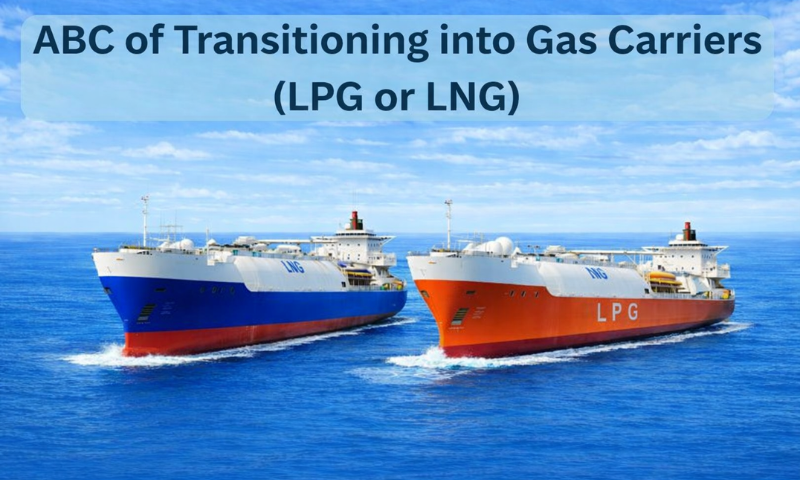
Transitioning into Gas Carriers (LPG or LNG) has become a natural career progression for many seafarers sailing on Oil/Chemical tankers, Bulk carriers, Car carriers, and Containerships. However, this transition is not automatic—it requires the right preparation, correct sequencing of courses, and a clear understanding of what companies assess during CBT (Computer based test) and interview stages. The ABC framework along with my personal experience below breaks this transition into simple, manageable steps, focusing only on what is required up to interview readiness.
A — Assess Your Entry Point
(Why Preparation Levels Differ)
Before starting Gas courses or applying to companies, it is important to understand how close your current experience is to gas carrier operations. This is not about capability, but about type of exposure.

Gas carriers involve:
- Active cargo systems (containment system as per IGC is one of the key)
- Continuous pressure and temperature control
- High automation and alarms
- Strict procedure-driven operations (highest safety standards)
- Critical shutdown systems
Different ship types expose seafarers to these elements in different ways, which only affects the amount of preparation needed before CBT and interview.
Simple overview:
- Oil / Chemical Tankers Already familiar with hazardous cargo handling and cargo operations → quicker alignment with focus on critical shutdown systems.
- Bulk Carriers Strong watchkeeping and safety discipline, limited cargo systems → needs cargo system focus with understanding of critical shutdown systems.
- Car Carriers (PCC) Good enclosed-space and fire safety awareness → needs gas process understanding alignment with cargo & critical shutdown systems.
- Container Ships High automation and alarm handling → needs gas behaviour and risk knowledge with focus on cargo & critical shutdown systems.
Personal experience:
I transitioned from Oil Tankers to Gas Tankers (LPG – VLGC). During my transition phase, even though my last ship was a Container vessel, I was still able to clear the process successfully. This reinforced my belief that background does not block transition—preparation defines success.
Key takeaway
No background is negative for seafaring transition roles. It only helps you decide what to study more before CBT and interview.
B — Build the Mandatory & Strategic Course Stack (Gas + IGF)

Step 3: Strategic IGF Courses (Alternative & Support Pathway)
For those considering Dual-Fuel or LNG/LPG-fuelled vessels as an entry or parallel route:
IGF Courses:
- Basic IGF Code Training
- Advanced IGF Code Training (rank dependent)
Why IGF matters:
- Demonstrates understanding of gas as fuel, not just cargo.
- Strongly supports applications for:
- LNG-fuelled container ships
- LPG-fuelled PCCs
- Dual-fuel bulkers and tankers
- Makes candidates attractive for companies operating both gas carriers and DF fleets.
Important: IGF does not replace Gas Tanker endorsements—but it strengthens interview outcomes and opens alternative entry routes.
Step 4: LCHS Simulator Training (Strongly Recommended)

- LPG or LNG Liquefied Gas Cargo Handling Simulator (LCHS)
- Focus on:
- System understanding
- Cargo flow logic
- Emergency response thinking
This significantly improves CBT pass rates.
Personal experience:
To prepare properly during my transition, I completed the GASCO Advanced course and LCHS, specifically to be ready for Management-level Gas DCE. This structured preparation made a major difference during CBT and interviews.
C — Choose Your Gas Pathway
(Including Alternative Entry Options)
Step 5: Select ONE clear pathway before CBT
Option 1: Direct Gas Carrier Route
- LPG Carrier (most common entry)
- LNG Carrier (limited entry, higher benchmark)
Option 2: Alternative Route via Dual-Fuel Vessels
- LNG-fuelled container ships
- LNG-fuelled bulk carriers
- LPG-fuelled PCCs / tankers
Industry reality:
- Dual-fuel vessels act as a bridge into gas operations.
- Many operators treat DF experience as relevant gas exposure.
- This route suits:
- Container / Bulk / PCC officers
- Engineers transitioning into gas systems.
Critical mistake to avoid: Applying simultaneously for LPG, LNG, and IGF roles without a clear story.
Personal experience:
I had a very clear goal—LPG ships. LNG opportunities were extremely rare at that time for Indian officers, so I focused on any LPG ship type—fully refrigerated, semi-refrigerated, or fully pressurised. This clarity helped me stay focused and realistic.
D — Company Applications (Decision making)
Step 6: Apply only after preparation.
Apply only when:
- Mandatory courses are complete.
- You can explain systems logically.
- You know which gas segment you are targeting.
CV must clearly show:
- Motivation for gas transition
- Courses completed (Gas + IGF if applicable)
- Willingness to start at junior / trainee level.
- Understanding of safety-critical operations
Personal experience:
I was sailing as a Senior 2nd Officer when I decided to transition. Every company offered me a 3rd Officer role, which I accepted without hesitation. This positive & flexible approach worked strongly in my favour.
E — CBT for Gas Tankers (Elimination Stage)
Step 7: Understand CBT (Computer Based Test) structure.
CBTs typically test:
- Gas properties & behaviour
- Pressure–temperature relationships
- Cargo system diagrams
- Safety devices & alarms
- Emergency scenarios
- Basic IGC / IGF principles
What CBT does NOT test:
- Memorised regulations
- Deep engineering design
- Terminal-specific procedures
Common CBT failure reasons:
- Weak fundamentals
- Guessing answers
- No simulator exposure
- Poor time management
CBT filters preparation—not experience.
Personal experience:
My Gas CBT was smooth, purely because of structured preparation and simulator exposure. CBT rewards understanding—not guesswork.
F — Final Interview Preparation (After CBT)

Step 8: Prepare for system-based interviews.
Interview focus areas:
- “What happens if…” scenarios.
- Cargo containment understanding
- Vapour handling logic
- Emergency response thinking
- Safety judgement under pressure
Expected at transition level:
- Logical reasoning
- Awareness of limits
- Calm decision-making
Not expected:
- Expert LPG/LNG reliquefication design
- Gas Terminal commissioning knowledge
Interviewers assess how you think, not what ship you last sailed on.
Personal experience:
After a strong CBT result, the interview felt like a natural extension of preparation. The impression created was strong enough that I was sent directly as 2nd Officer onboard a VLGC, without any parallel training requirement—something that clearly showed how much CBT + interview performance matters.
Final Takeaway
Successful transition to gas carriers up to CBT and interview is the result of doing a few things in the right order:
- Assess your background realistically (Section A)
Understand what your ship type has already prepared you for—and what needs extra focus. Background is not a barrier; preparation closes the gap. - Build readiness before applying (Section B)
Gas and simulator training create confidence. Courses are not paperwork—they form the foundation for CBT and interviews. - Choose one clear entry target (Section C)
A focused goal (such as LPG first) strengthens applications and avoids diluted effort. - Apply with flexibility and intent (Section D)
Readiness and attitude matter more than rank. Being open to a step-down often accelerates entry. - Prepare to pass CBT, not guess through it (Section E)
CBT rewards understanding of systems and logic, not memorisation. - Let preparation carry the interview (Section F)
Strong CBT performance and clear thinking naturally translate into confident interviews.
Gas shipping does not reward shortcuts—but it consistently rewards structured preparation.



Capt. Bhupinder S. Kahlon
Certified Career Analyst (CCA)
- 10+ years of experience as a Master Mariner & 30 years in the maritime, oil & gas industries.
- Global exposure to diverse challenges and opportunities, helping me understand career transitions and industry growth.
- Mentored numerous young professionals, guiding them in their careers of future.
- Starting up of VSEA FUTURE, a platform dedicated to helping individuals make informed career choices across various sectors.
Leave a comment
View more
Give your career a boost with S&B professional services.
CV Prep/Evaluation Prep Service
 More Jobs
Ship management
Mumbai
Senior Executive – Brandin..
Ship management
Mumbai
Assistant Manager – Vessel..
Ship management
Mumbai
HR Officer
Interview Prep/Mentoring
Find your polestar with the host of experts available on our platform
Know more

Contact Us