
Difference between Indos, SID, and CDC
 Sea and Beyond
14 Feb 2026
2857 view
0
0 Comment
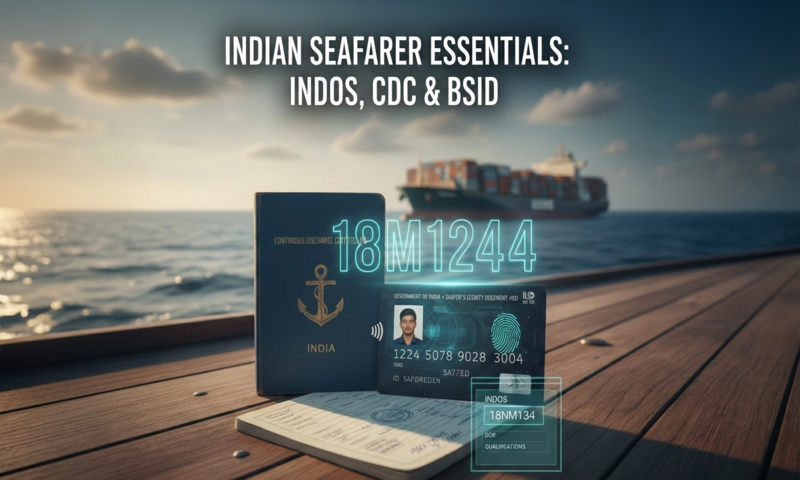
For Indian seafarers, three key identifiers and documents play essential but distinct roles in their professional lives: the INDOS number, the Continuous Discharge Certificate (CDC), and the Seafarer's Identity Document (SID), commonly referred to as the Biometric Seafarer's Identity Document (BSID) in its current form.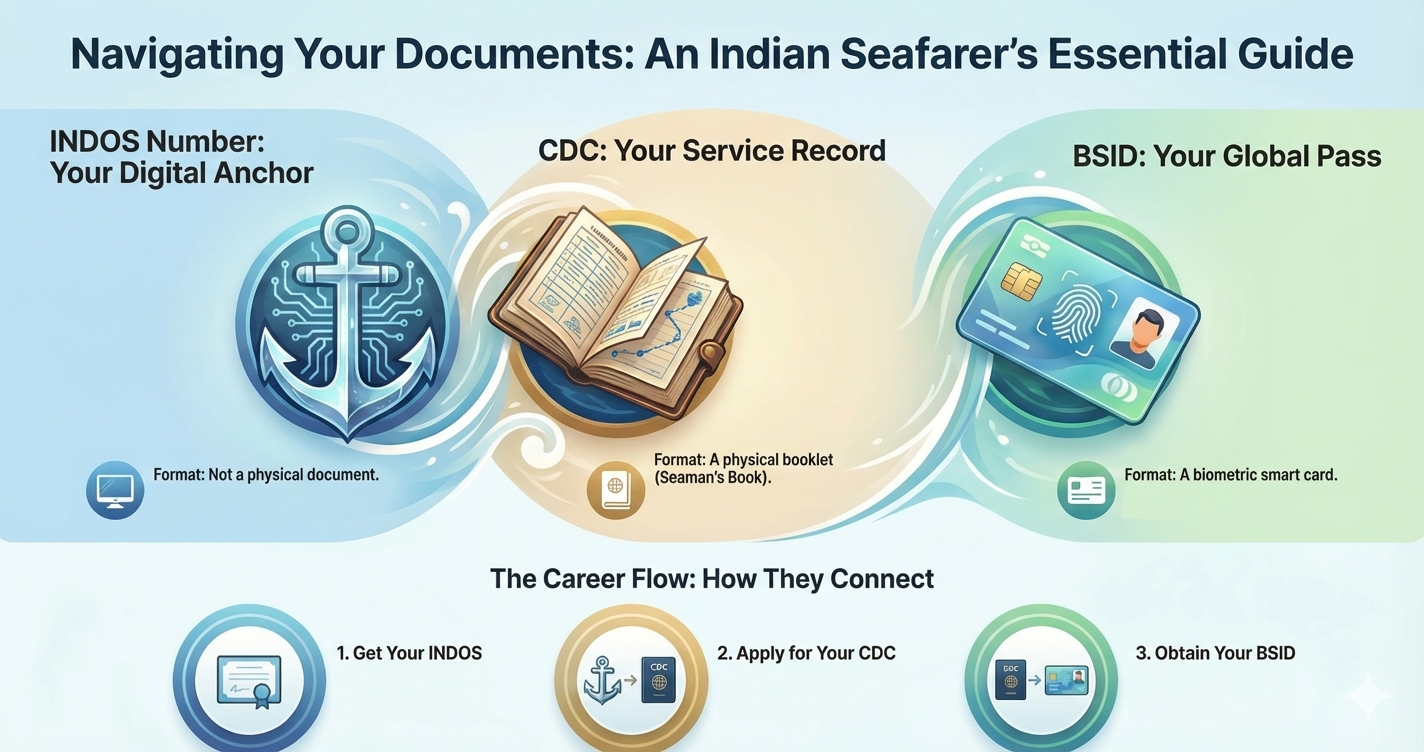
The INDOS number, which stands for Indian National Database of Seafarers, is a unique eight-character alphanumeric identifier (such as 18NM1234) assigned by the Directorate General of Shipping. It serves as your permanent digital identity within India's centralized seafarer database, linking all your personal details, qualifications, certificates, and records to prevent fraud and enable quick verification by authorities, employers, flag states, port states, and immigration officials. This number is typically generated automatically when you enroll in your first DG Shipping-approved pre-sea training course, and it remains with you for life. It is not a physical document but a core reference required for almost every subsequent maritime process, including course enrollments, certificate applications, and profile updates on the e-governance portal.
In contrast, the CDC, or Continuous Discharge Certificate, functions as your official sea-service record book and primary seafarer identity document under Indian maritime law. Issued by the Shipping Master, it is a physical booklet (often called a seaman's book) that records every voyage you undertake, including details like vessel name, gross tonnage, your rank, joining and sign-off dates, ports of call, and the master's signature for each entry. This accumulated sea time is vital for proving eligibility for promotions, higher certificates of competency, and examinations. The CDC is mandatory for legally sailing on merchant vessels, whether Indian or foreign flag, and it requires periodic renewal. While it once combined identity and service record functions, modern regulations have separated these roles.
The SID/BSID is a separate, standalone biometric identity card introduced to comply with ILO Convention 185, which India has ratified. Issued as a plastic smart card since around 2019, it contains your photograph, personal information, signature, and biometric data (such as fingerprints and iris scans) along with a unique number and barcode. Its primary purpose is to facilitate quick and secure verification of your status as a genuine seafarer, easing shore leave, transit, crew changes, repatriation, and border crossings in many countries without additional visa complications. Unlike the CDC, it does not record sea service; instead, it focuses on international recognition and rapid immigration processing. To obtain a BSID, you must already hold a valid Indian passport, a current CDC, and an up-to-date INDOS profile, with biometrics captured at designated centers.
In practice, these three elements interconnect seamlessly in a typical seafarer’s journey. You first receive your INDOS number during initial training, which then enables you to apply for your CDC to begin logging sea service. Once you have a valid CDC, you can proceed to apply for the BSID, which draws details from your INDOS profile and serves as your modern, globally compliant identity credential. Today, possessing a valid BSID is practically compulsory for joining merchant vessels, while the CDC remains essential for documenting experience, and the INDOS number ties everything together in the background as your lifelong digital anchor In the Indian database.
Keeping all three current and accurately linked is crucial for smooth career progression, compliance, and international mobility in the merchant navy. Regularly check your INDOS profile on the DG Shipping portal, renew your CDC as required, and ensure your BSID enrollment is complete to avoid any disruptions at sea or ashore. Safe voyages ahead!
This Blog is authored by Akshay Shrivastav

Details about the Author
Akshay Shrivastav holds a Bachelor's degree in Nautical Science from Indian Maritime University, complemented by pre-sea training at the International Maritime Institute. He currently serves as a Navigation and Operations Officer at Anglo-Eastern, managing ship navigation, cargo operations, and logistics with expertise in vessel oversight, tank cleaning coordination, and safety compliance during loading and unloading. At Anglo-Eastern, Akshay Shrivastav collaborates with teams to command vessels, streamline maritime operations, and assist senior officers in preparing for inspections and audits to uphold top standards. Driven by safety and precision, he seeks to apply a structured, detail-focused mindset to drive organizational success, while promoting teamwork and operational efficiency.



Sea and Beyond
At Sea and Beyond we strive for authenticity and honesty in our work. Our mission is to help “You take a well informed decision” and we try and support you through our various services like
- Mentoring
- Skill enhancement/Education
- Job Opportunities and
- Your branding (CV and LinkedIn preparation)
We have a team of writers who conduct thorough research to ensure the accuracy of the content and for the clarity in communication. We will be happy to support you wherever required
Leave a comment
View more
Give your career a boost with S&B professional services.
CV Prep/Evaluation Prep Service
 SeaCommerce
Shop maritime books & essentials
DG Medical Examiners
Find approved doctors near you
Tools & Calculators
Free maritime tools for seafarers
More Jobs
Agency and Logistics
Tanzania
Commercial Manager – Tanza..
Misc
Mumbai
Front Desk Executive – Mum..
Sales and Marketing
Mumbai
Sales Manager
Interview Prep/Mentoring
Find your polestar with the host of experts available on our platform
Know more