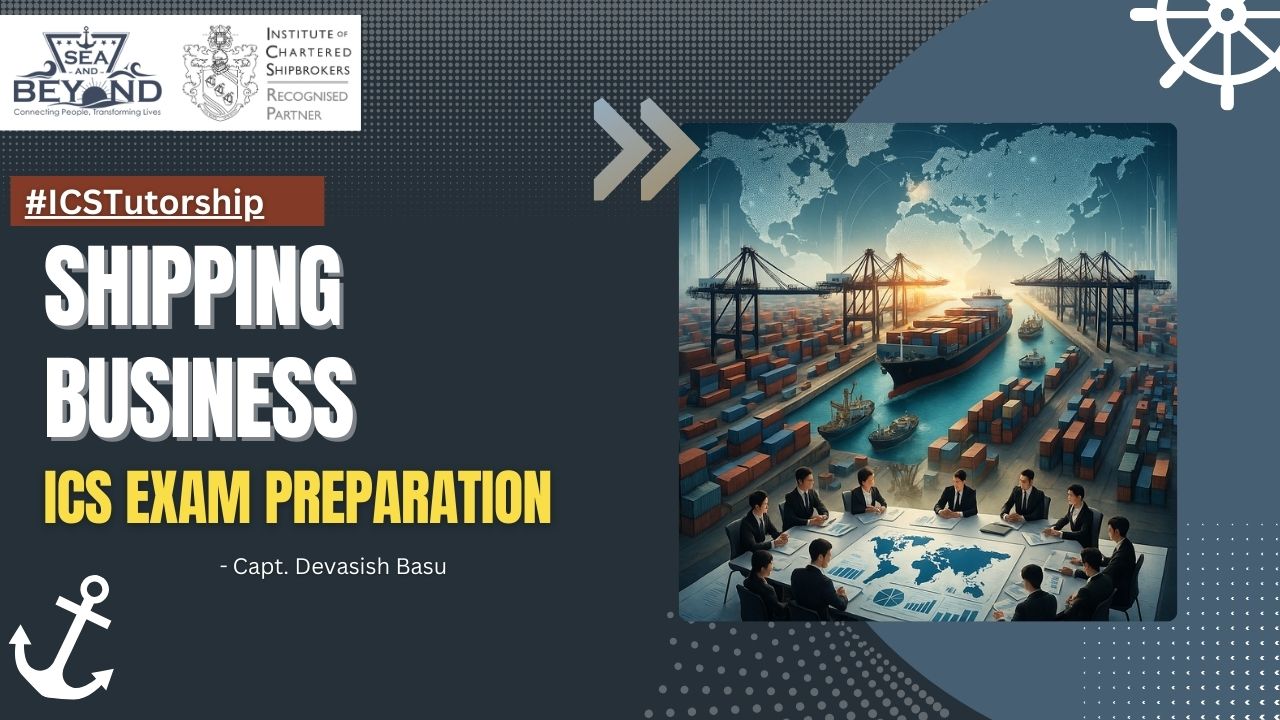
The ICS Tutorship on Shipping Business, conducted by Capt. Devasish Basu, is a structured, video-based learning programme designed specifically for students preparing for the Institute of Chartered Shipbrokers (ICS) Shipping Business examination.
This course is ideal for aspiring shipbrokers, seafarers transitioning to shore-based roles, and maritime professionals seeking a clear, exam-focused understanding of Shipping Business concepts. Delivered through 11 comprehensive recorded video chapters, the programme ensures complete coverage of the official ICS syllabus, while simplifying complex topics through practical explanations and real-world examples.
Course Structure and Syllabus Coverage
Company Structures and Financial Fundamentals
The course begins with an introduction to company and organizational structures within the shipping industry. It covers types of company registrations, shareholding patterns, and an overview of profit and loss (P&L) statements, providing a strong financial foundation for understanding shipping businesses.
Ships, Trade, and Operating Environment
Subsequent chapters examine types of ships, their design and construction, and how these factors influence commercial operations. The course then moves into trading areas, addressing operational limitations and disruptions arising from world geography, trade routes, and economic and political influences affecting global shipping.
Chartering, Sale and Purchase, and Ship Management
Key chapters focus on chartering market practices, explaining different charter types and commercial considerations. The course also covers the purchase and sale of vessels, along with an overview of ship management practices within the broader shipping business framework.
Shipping Agency and Documentation
The programme provides a detailed understanding of shipping agency functions, covering the duties of owners’ agents, charterers’ agents, and liner agents. It explains the roles, responsibilities, and documentation handled by shipping agents, ensuring clarity on an essential operational area tested in the ICS examinations.
International Trade, Contracts, and Shipping Finance
The later chapters focus on international trade and finance, including shipping contracts and INCOTERMS. The course then examines finance in shipping markets, covering payment methods, Letters of Credit (LC), foreign exchange, and marine insurance practices, all aligned with the ICS Shipping Business syllabus.
Business Ethics, Compliance, and International Bodies
The final academic sections address business ethics, including types of fraud in shipping and trade, followed by an overview of anti-bribery legislation under both international and national laws. The course concludes with discussions on international bodies and forums relevant to global shipping trade and business.
ICS Exam Guidance
In addition to subject content, the course includes dedicated exam guidance videos that explain how to structure answers, approach different ICS question types, and manage time effectively during the examination.
Who This Course is for
- ICS students preparing for the Shipping Business examination
- Aspiring shipbrokers and shipping professionals
- Seafarers planning a transition ashore
- Maritime professionals seeking a structured understanding of shipping business fundamentals
Learning Outcomes
By the end of the course, students will have a clear conceptual understanding of Shipping Business, strong familiarity with ICS exam expectations, and the confidence required to sit the ICS examination and pursue a career in shipping and maritime trade.

Devasish Basu
Capt. Basu is a highly respected shipping professional with over four decades of rich experience across sailing and shore-based operations. Having served on a wide range of vessels — including general cargo ships, tankers, bulk carriers, passenger ships, and OBOs — he rose through the ranks to Master before transitioning ashore. His shore career includes leadership roles in chartering, broking, agency management, and port operations, with over 21 years dedicated to heading major divisions in reputed shipping companies. An ex-pilot with the Gujarat Maritime Board and a senior leader at organizations like Parekh Marine, Everett India, and Essar Shipping, Capt. Basu is deeply passionate about mentoring the next generation of maritime professionals. Currently serving as visiting faculty at Navi Mumbai MTI, he brings a wealth of practical knowledge, strategic insight, and a lifelong commitment to maritime excellence to his courses.
Rating:
Price:
₹ 14999
Language:
English
Length:
11:05:00
Intended for:
Reference:
Topics:
12 Sections . 18 lectures . 11h 5m total length
45 min
1.1 Chapter 1 | Business Entity, Sole trader, Partnership firms
The Business Entity, Sole trader, Partnership firms, Limited Liability companies (LLPs), Private limited & public limited company, share holding patterns, shareholders, Capital and borrowing from institutions, Mortgage,
Incorporation of a company, process of registration, various types of company structures, Integration in Business, Company organisation and management, Balance sheet, statutory accounts, Profit & loss (PNL) account, Assets in a company
19 min
2.1 Chapter 2 | Type of ships, Bulk carriers, trade routes
Type of ships, Bulk carriers, Features and trade routes, Specialized Dry bulk ships, regional classification of Bulk carriers, construction and design, cross section

28 min
2.2 Chapter 2 | General cargo Ships, Multi-purpose ships, PCCs
General cargo Ships, Multi-purpose ships, PCCs, reefer vessels, Features including drawings and cargoes, container vessels- types/sizes/trades
32 min
2.3 Chapter 2 | Capacity terminology, Crude Tankers-Types/sizes
Key dimensions, Capacity terminology, Crude Tankers-Types/sizes, Key trade routes, cargo details,
Product tankers, Chemical tankers, Gas carriers, LNG and LPG carriers, construction design of various types of tankers
49 min
3.1 Chapter 3 | Geography of trade, Trading Restraints, Navigation
Geography of trade, Sources of information about ports, Trading Restraints, Navigation, weather effects, Planning a shipping route, canals & waterways, Political disruptions, examples of disruptions, Port of Convenience (POC), ITF actions & Impacts
52 min
3.2 Chapter 3 | Port information, Port restrictions, Agent’s expertise
Port information, Port restrictions, Agent’s expertise on local ports, Cargo-Primary source areas, Cargo- Primary consumption areas, waterways, restrictions on trade routes, Various cargo routes, Grain, Oil & Gas, Economic factors affecting trade, Environmental issues and regulations
40 min
4.1 Chapter 4 | Chartering market & practices, Baltic Exchange
Chartering market & practices, Baltic Exchange, Freight rate indices, Baltic dry index (BDI),Key features of BDI, Freight derivatives and FFA’s , FFA trading & settlement, Freight market stakeholders, Charterers, Ship owners, Operators, Ship brokers, Trading practices, INCO terms
32 min
4.2 Chapter 4 | Freight market analysis, Types of charter
Freight market analysis and reporting, Methods of ship employment, Types of charter, Voyage charter, Consecutive voyage charter, Time charter, Bareboat (demise) charter, COA, Market reporting, Tanker charter party, ShellVoy6, Worldscale index, Bills of lading
50 min
5.1 Chapter 5 | Ship sale & Purchase, Ship recycling market
Ship sale & Purchase, Ship recycling market (demolition), New buildings process, Second hand vessels, S&P brokers, Process of selling a ship, Norwegian saleform, Pre delivery inspection, Drydock prior to sale, Post sale process, Demolition sale process, valuation of vessel, Ship management
39 min
6.1 Chapter 6 | Agent’s role & responsibility, shipping port agent
Agent’s role & responsibility, shipping port agent responsibilities, Statement of Fact, agent provided services, Categories of agents, Port/Cargo/Charterer agent
36 min
6.2 Chapter 6 | Liner agents, Owner’s & Character’s agents
Liner agents, Owner’s & Character’s agents, Duties of agents, Agents duties at Indian ports, Stakeholders involved, Documents handled by agents, Error & omission protection
38 min
7.1 Chapter 7 | International trade and finance, contract elements
International trade and finance, basic contract elements, Goods and Property, Risk passing in a contract, INCO (International commercial) terms, Remedies for breach of contract, remedies of seller and buyer, Lien, Law & jurisdiction in a dispute
34 min
8.1 Chapter 8 | Finance and insurance, payments methods
Finance and insurance in international trade, Overview of payments methods, cash with order & open accounts, Bills of Exchange- Key parties & benefits, Letters of Credit(LC) explained, Invoices & Insurance certificates, Bill of Lading, waybills, regulatory mechanisms, Tariffs & duties, Licensing & Quota, Foreign exchange, currency transactions, Currency hedging, Freight hedging (Futures), Marine Insurance coverage and policies, Claims procedure, Principle of average, Future trends

45 min
9.1 Chapter 9 | Business ethics, Insurance & Documentary Fraud
Business ethics, Ethics in Shipping Business, Insurance Fraud, Documentary Fraud, Case study, Fraud consequences, Other areas of Fraud, Misinterpretation on B/L, Misdeclaration of quantity/Quality or freight, Payment fraud, Mitigation, Other criminal activities, contrabands, smuggling, Preventive measures, detecting & avoiding Fraud, role of enforcement, Baltic exchange guidance, Broker/Principal conduct, Conclusions

50 min
10.1 Chapter 10 | Anti-bribery compliance, legislation, OECD
Anti-bribery compliance — challenges in shipping, Anti-Bribery legislation, OECD anti-bribery convention, Prevention of Corruption act, India (1988), Exceptions, Facilitation payments, commercial coercion, Anti-Bribery policies, Risk Assessments, related challenges in shipping, Due diligence, Compliance with Anti-Bribery laws, reporting of breaches, Best practices to fight corruption
25 min
11.1 Chapter 11 | International Shipping Organizations
International Shipping Organizations, Ship Owner’s Org, International Chamber of Shipping(ICS), BIMCO,INTERTANKO, INTERCARGO, OCIMF
Broker’s & agent’s Org, ICS, The Baltic Exchange, FONASBA, FIATA (International Federation of Freight Forwarder's Associations), IMO, UNCTAD, ILO
24 min
11.2 Chapter 11 | Organizations, IACS, Seafarers support, ITF, ISWAN
Organizations, IACS (classification Societies), Llyod’s Register, Seafarers support, ITF, ISWAN, Mission to seafarers, Insurance Orgs, IUA (underwriters), Llyod’s, LMA, IGP&I, Other bodies, ICC, IMB, Interconnection of these Orgs, Challenges & future trends

27 min
12.1 Q & A | Role of Ship management companies
Answering the question about role of Ship management companies, pros and cons of their use
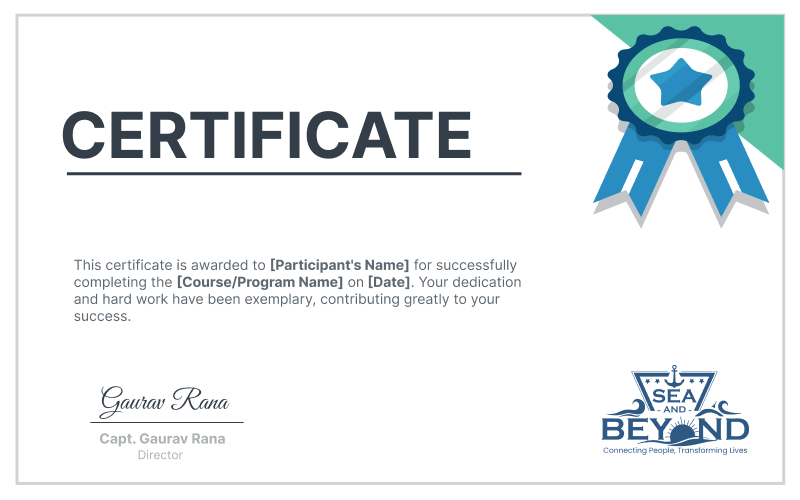
Successful completion of this course will earn you a certificate of completion from Sea and Beyond. This certificate will be emailed to you and you could also share and show it on LinkedIn Please click on the button below to purchase the certificate.
Similar Courses





Reviews...
Yogesh Thakkar On Jan 6th 2026
Very nicely explained....
Rachel Lee On Mar 17th 2026
Shipping business concept....






Contact Us